After the first analysis carried out on how a spray gun can ruin your paint job, today it is time to analyze other aspects that can also influence this fatal outcome, so, let’s go.
Types of spray gun used in Car Refinish
There are different ways of classifying spray guns, the most common being those that group them based on the feed system, their transfer rate and their size. Knowing these settings helps us choose the most suitable one for each job, so don’t forget that knowing this information will prevent a spray gun from ruining your paint job.
Types of spray guns according to their feed system:
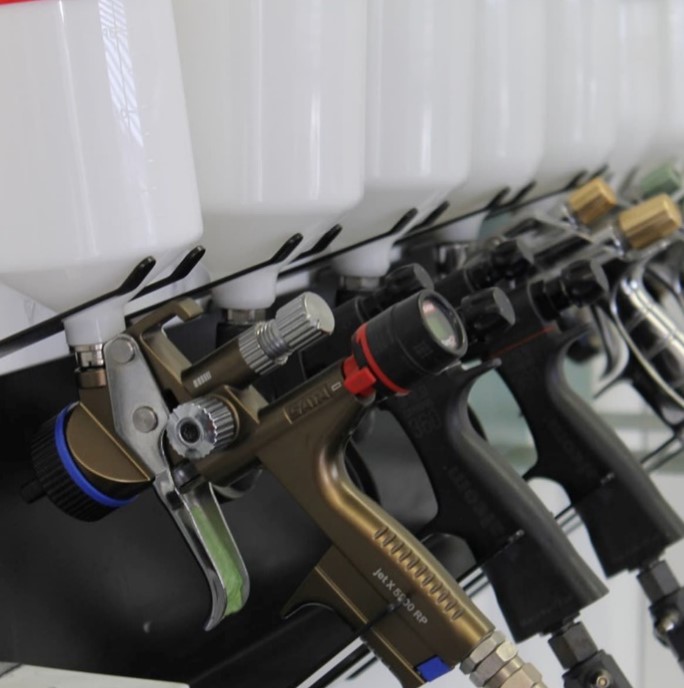
- Gravity. It is currently the type most commonly used in automotive bodyshops and other industries where medium or small surfaces are coated. The particularity of these guns is that the cup or tank, the part in charge of storing the paint, is located at the top. From the cup, the product is introduced into the gun by the effect of gravity itself. This assembly facilitates the application and allows optimal emptying of the tank.
- Siphon. This variant is less common in the automotive industry and more in industry. In this case, the tank is located in the lower part of the gun, so that the paint is introduced through a tube that sucks the product up. This structure is more cumbersome to handle and tends to prevent complete emptying of the tank.
Types of spray gun according to transfer rate
The transfer rate of a gun establishes the percentage of paint that is deposited on the surface with respect to the total amount of paint used. This value directly influences such important aspects as paint consumption, filter saturation, overspray generated during application and the impact on the environment and people’s health. Based on this value, we find the spray gun variants shown in the following table:
Conventional:
- It is the oldest technology when it comes to spray guns.
- They have a very low transfer rate of around 35%, which in other words means a waste of ⅔ of the paint used.
- They work with high air pressures of the order of 3 and 4 bar, which explains their low transfer rate and the overspray they cause. This circumstance also generates a greater deterioration of the paint booth filters and a greater polluting effect on the environment and people.
- Main application: To apply paints that, due to their higher viscosity, generate a smaller spray cloud, such as base paints: primers or spray putties.
HVLP Spray guns
- They were created to improve the transfer rate of conventional spray guns, so they increase said value up to approximately 65%. To do so, these spray guns work with a high volume of product and an air pressure of around 2 bar. Hence the name High Volume Low Pressure.
- As a result, they generate less over spray, which reduces filter saturation and the risk to people and the environment.
- Main application: for applying two-coat base coats, enamels and any other topcoat as long as it does not involve large surfaces.
High transfer spray guns (HTE)
- As the name indicates, this type of gun is a mixture of the conventional system and the HVLP, in such a way that it presents the advantages of both systems.
- It offers dynamic and fast application thanks to its powerful fan, but without the need to work with high air pressure, since it does so at around two bars. This reduces the polluting effect and a high quality finish is obtained.
- Main application:To apply lacquers, clear coats, monolayers and enamels that require a good visual finish.
Types of spray gun according to their size
It is the type of classification of the spray guns used in car refinish that is less technological, but no less important. Under this grouping we have standard size spray guns, which are used for general work of all kinds and have a 600ml cup, and retouching spray guns, which are characterized by their smaller size, for mounting a 200ml cup and for having been designed to carry out blending and small paint touch-ups, since it has a smaller fan, they hardly generate overspray and allow for increased precision of the application in more localized areas of work.
Regulation of painting parameters and painting technique
- The regulation of the painting parameters of the spray gun and the correct application of the painting technique is crucial to guarantee a perfect atomization of the paint that ensures obtaining a uniform paint film, with sufficient thickness and without surface defects. The correct adjustment of the spray gun and the execution of the painting prevents a spray gun from ruining your paint job, so the basic regulation and execution aspects to be taken into account before application are listed below.
Regulation of painting parameters
- Product flow. Most spray guns provide a sufficient amount of paint by opening the corresponding regulator between 2.5 and 3.5 turns.
- Fan. It should fully open less one quarter of a turn. When it is intended to paint a closed area, the fan can be closed to facilitate coverage, taking into account that the spray pattern becomes circular and the paint deposit will be more concentrated.
- The air pressure reaching the spray gun inlet is 3-4 bar for conventional guns and 2 – 2.5 for HVLP and High Transfer (HTE) spray guns.
Basic painting technique
- Keep the spray gun perpendicular to the part, mimicking its shape during the advance. In this way over sprays and dry applications are avoided. In the case of blending or transitions between pieces, it is possible to break this perpendicularity in the transition area to obtain a correct paint gradient.
- Keep a distance between the spray gun and the piece of between 10 to 15 cm for HVLP spray guns and up to 25 for conventional and high transfer (HTE) spray guns.
Don’t let a spray gun ruin your paint job!
As we have analyzed in these two articles, a spray gun can ruin your paint job, so remember that taking these aspects into account will avoid greater evils:
- Handle the spray gun and its components with extreme care to avoid damage.
- Store and secure the spray gun to avoid dropping or knocking it.
- Choose the size of the fluid tip, the needle and the nozzle most suitable for the viscosity of the product or paint used.
- Select the most suitable type of spray gun for each type of work.
- Conveniently regulate the spray gun.
- Apply the product or paint following the basic painting technique.
We hope this information is useful See you in our next post!