Plastic repair generates a certain amount of skepticism in bodyshops, especially with regard to repairing the damage itself. However, certain practices have also become standardized in the paint area that detract from the quality of work performed on certain plastic materials.
For this reason, our publication today is aimed at showing, or rather, at seeking efficiency in the repair of plastics as a way of making the repair profitable without compromising the quality of the repair.
Can you think of any materials, tools or work processes that can help you achieve this? We’re sure you can, but we can guarantee that we’re going to surprise you.
Here we go!
Damage typical of plastic repair
The most common damages that occur on plastic materials and require repair are as follows:
- Cracks or breaks.
- Lack of material.
- Cracking of the paint.
- Chipping of the paint.
Of all these, cracks, tears, missing material and deformations require the intervention of the refinisher as a general rule, while superficial flaws that occur on the paint, such as scratches, cracks and chipping, are usually repaired directly by the painters.
In any case, seeking efficiency in the repair of plastics and their subsequent painting is crucial to improve the profitability of the repair while maintaining the appropriate quality standards, so below we analyze how to achieve this goal.
How to achieve efficiency in plastic repair work
Within the field of damage repair on plastics, the following jobs are particularly important from the point of view of efficiency and quality:
- Before applying any product (putty, adhesive, etc.) it is necessary to sand the damage and its bordering area with sanding grains between P-120 and P-240, blow and degrease the surface with a specific cleaner valid for plastics, such as Degraser 226 together with ROBCLOTH DC 1000.
- To finish evening out the repaired damage, a putty specific for plastics should be used, such as Multiplast, which guarantees good adhesion and flexibility. In any type of repair, avoid applying thick coats of putty.
- When repairing cracks and/or missing material, the reinforcement of the internal face of the damage should always be reinforced to give the repair adequate strength. By using welded staples or thermoplastic patches, the work process is streamlined, increasing efficiency.
On one hand, it may also be that the damage to the plastic is minor or superficial. In these cases, the damaged plastic part goes directly to the paint area, where the damage must always be sanded and then primed.
On the other hand, if the damage is not so superficial, the sanding must be more aggressive to eliminate the anomaly. If, after sanding, the damage has not been corrected or unevenness is detected, the area must inevitably be filled, considering the same precautions mentioned above.
How to achieve efficiency in plastic painting work
Once the damage to the plastic has been repaired, it is time to start the paint work processes, which are the primer and the application of the topcoat paints.
And it is at this point that we unveil the surprise we mentioned earlier. Roberlo has developed a new Omniplast additive, which is added to conventional primers (2-component spray gun primers) and UV primers for direct application to plastic substrates.
As a result, the primer application process is considerably speeded up, as it eliminates the need to apply an adhesion promoter beforehand, the wait caused by evaporation times and adhesion failures due to product overload, as they are integrated into the primer mixing process.
The proportion of additive to be added to the primer depends on the type of primer to be used and the brand in question that manufactures it. as an example, these are the percentages of additive by weight with respect to the primer used from the manufacturer Roberlo:
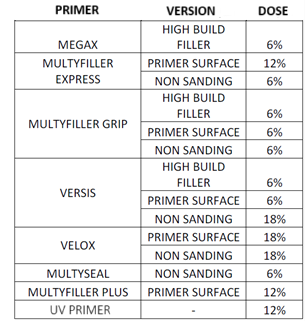
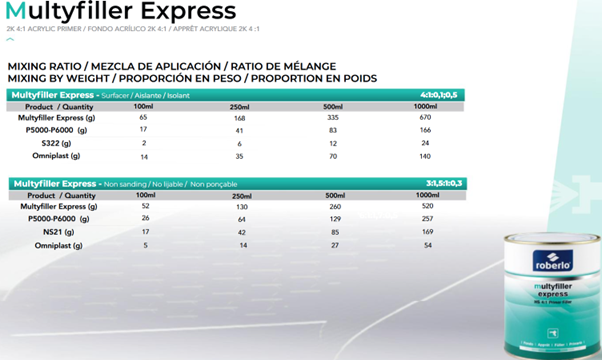
To facilitate the mixing process and avoid calculations, this same manufacturer also offers a mixing chart with standardized quantities as the example shown in this image for a 2-component acrylic primer:
However, this additive can also be used as a conventional adhesion promoter, as it can be applied separately prior to the application of the primer. This type of application can be very interesting when the objective is to take advantage of its marked adhesion power, since in this way it is possible to achieve the maximum possible adhesion power. Even so, when it is decided to use it in this way, the following issues should be taken into account:
- Sanding is required prior to application with sandpaper grit between P-240 and P-320, and subsequent blowing and degreasing of the surface.
- The additive can be applied directly, so it does not require hardener or dilution.
- For its application an aerographic spray gun with a fluid nozzle of 1.2 or 1.3 is used.
- Application at a pressure between 1.8 and 2 bar.
- One coat application.
- Dry between 10 and 15 minutes. Once this time has elapsed, the chosen primer can be applied.
Achieving efficiency in plastics repair is now a reality
Like almost everything in life, when we look for something with impetus, it is more than probable that we will end up finding it. And this is what happens when we talk about efficiency in plastic repair, because when the right work processes are applied and innovative products such as those we have seen and analyzed are used, it is possible to make a repair profitable while increasing the quality offered.