If look at a literal explanation of the term, it is a lining for a bed or mattress, something that, a priori, has little to do with the automotive or industrial sector, but in reality it does have a relationship.
So what is a bedliner? Initially, the bedliner was designed as a complement to cover the box or cargo area of vehicles, especially those intended to transport loads that, due to their characteristics, could slide or damage this part of the bodywork. However, the evolution of this product has meant that today it is also used in industrial sectors, beyond trucks and pick-ups, thanks to its resistance, versatility and the multitude of applications it offers in the following sectors:
- Automotive
- Rail
- Naval
- Construction
- Storage of raw materials, chemical products, etc.
Due to this versatility, in today’s article we want to clarify any questions that may arise regarding the functions of a sprayable bedliner, its characteristics and its applications, so, below, we detail information and examples of this very useful solution.
Functions and characteristics of a bedliner
As we already know, the bedliner is used as a protection element for vehicle loading areas, although it has other functions, such as:
- Eliminate slippage from the surface that has been coated.
- It helps to prevent premature deterioration of the treated surface.
- It improves the appearance and the visual appeal of the coated surface.
- It can be used as a personalization element.

Regarding its main features, the following particularities stand out:
- It is marketed in black and in a color-ready version, in order to obtain the desired color or customize the final finish.
- It is a product that can be refinished, so it can be covered with water-based and acrylic topcoat paints.
- It is a type of polyurethane acrylic-based catalyzed paint that is applied with a specific suction gun, like the one used to apply other products such as anti-gravel.
- It provides comprehensive corrosion protection of the entire coated surface, eliminating the existence of joints or dead zones typical of other systems through which deterioration of the substrate can begin,
- It allows you to coat any type of metal surface in order to protect it against different types of aggression, thanks to its excellent adhesion to steel, galvanized steel and aluminum. In addition, it can be applied on other substrates and coatings such as plastics, cataphoresis, primers, etc.
- It offers very good resistance to different types of aggressions: physical (scrapes, abrasions, small bumps, etc.), chemical (fuel, acetone, ammonia, oils, etc.), environmental and thermal (withstands up to 85 ºC).
- The resulting product film exhibits a high degree of hardness and flexibility after drying.
- It cleans easily.
- Its Application Process is easy and it does not require any knowledge beyond what a workshop operator must have.
The touch dry time at 20ºC is 45-60 minutes, while its final drying is 2 to 3 days for light loads and 7 days for heavy loads. Infrared drying is not recommended
How to apply a bedliner
The process of using and applying a bedliner is:
- Clean the loading area or the surface to be coated with pressurized water to remove any remaining solid dirt.
- Degrease the loading area to remove traces of contaminants such as grease or oils. To this end you can use a solvent-based degreaser with high cleaning power, such as DA93.
- Sand the surface with a coarse grain between P-80 and P-150. If the loading area or surface has many ribs or contours, it is recommended to use finer sandpaper grains and sand by hand so as not to inadvertently uncover the sheet metal with the sanding machine. In the case of coating steel, sanding is not necessary.
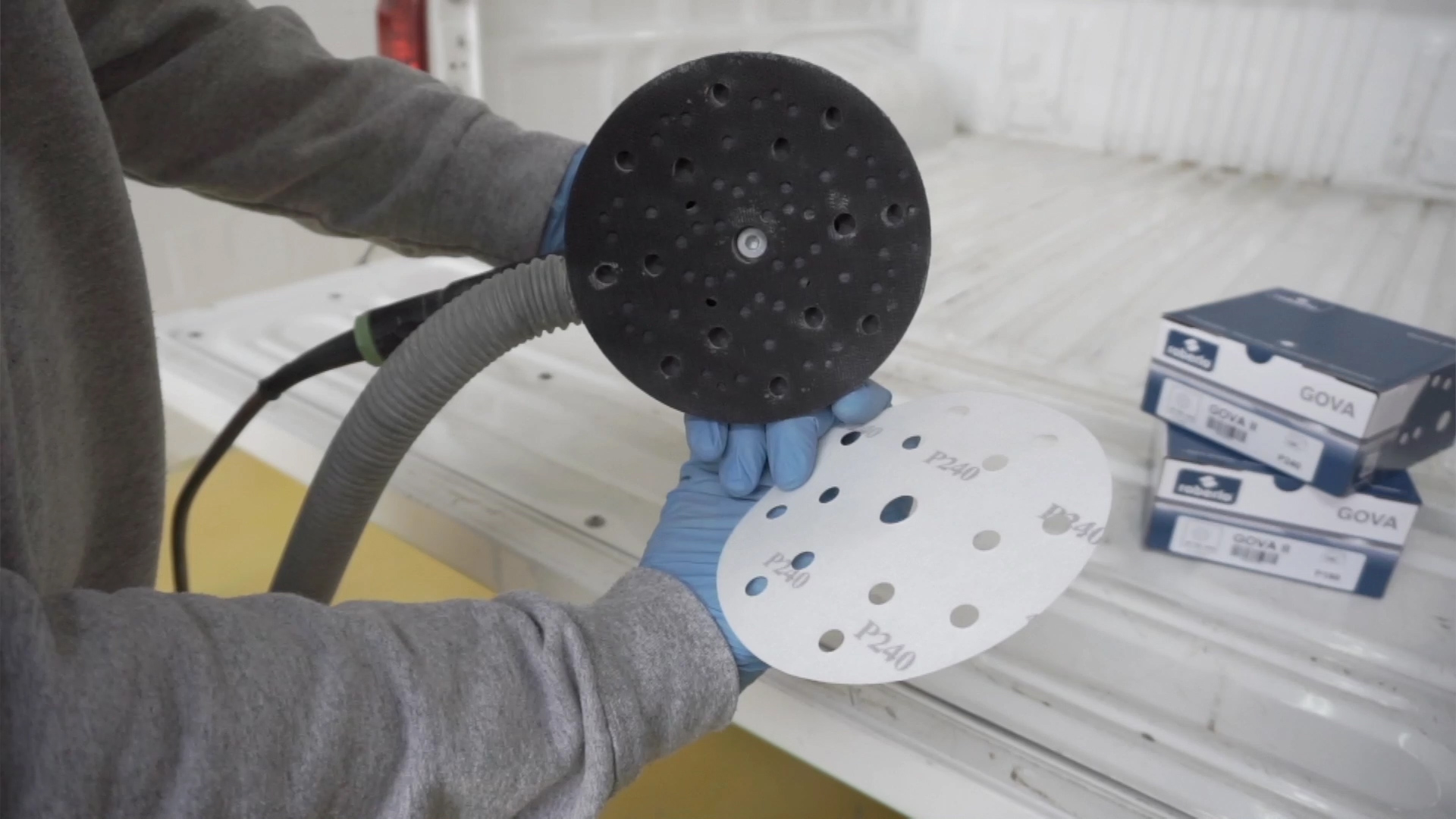
- Remove the dust generated during sanding and degrease the surface again.
- If working on a vehicle, move it into the paint booth.
- Mask the areas and zones that are not going to be covered, in order to avoid spraying or staining them during application.
- If working on the vehicle, cover any bare metal surfaces that may have been generated after sanding. To carry out this work quickly, it is recommended to use an aerosol component primer such as ETCH PRIMER 1K.
- Shake the sprayable bedliner container for two minutes.
- Mix in the bedliner hardener, taking into account the mixing ratio established by the manufacturer. When required, the product should also be tinted. The dyes used are solvent-based concrete pigments, such as the Disolac system, and are added to component A, that is, in the amount of bedliner chosen, at a percentage of 5%
- Assemble the product bottle on the spray gun.
- Carry out a series of application tests to determine the most suitable working pressure and application distance for the type of roughness desired.
- Apply the product to the work area, respecting the chosen distance and working pressure. It is important that each pass overlaps the previous one to achieve correct coverage and a sufficient and uniform bedliner thickness.
- Clean gun and dispose of excess bedliner in the waste container for paints.
- Wait for the drying time indicated by the manufacturer.
Bedliner: the most effective remedy to protect surfaces exposed to aggression
The bedliner allows us to protect the loading area and other types of surfaces exposed to different types of mechanical, chemical or environmental aggression. The sprayable bedliner has some very specific characteristics that make this coating an option for great versatility and resistance that offers substantial advantages in different types of vehicles and productive sectors.