Aerosol paints have been part of the refinishing world for decades. During all this time, their presence in manufacturers’ paint ranges has only grown, to the point where they have become an important part of everyday life in a multitude of sectors. This growth is due to the multiple advantages they offer over certain traditional products. However, they remain a format with very specific characteristics that inevitably determine their fields of application.
Do you want to know first-hand how aerosol paint can become your perfect ally for touch-ups and avoiding a full paint job? Below, we show you the most important aspects for achieving this.
Why is aerosol paint the perfect ally for touch-ups and avoiding full paint jobs?
Aerosol paint is the perfect ally for touch-ups and avoiding complete refinishing due to the many all-round benefits of this paint format. In addition, aerosol paints are an ideal complement in the various stages of refinishing parts, increasing the productivity of the work carried out. The main advantages are as follows:
- It is a format designed to increase productivity at certain points in the repair process (covering bare metal bald spots, surface activation, etc.) or when it is necessary to carry out touch-ups or painting of small parts.
- They are ready-to-use paints, eliminating the need for traditional mixing processes.
- They are easy to apply and are sprayed directly from the paint can itself, so there is no need to use and clean spray guns.
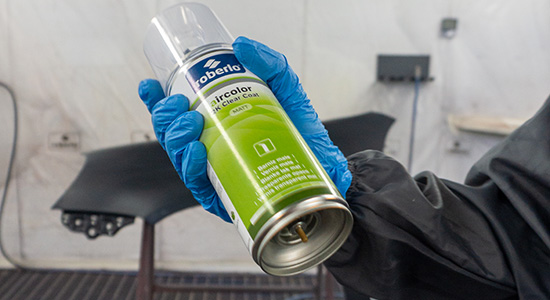
- There are different types of aerosol paints to suit the type of work to be done. Depending on the aerosol paint in question, traditional one-component (1K) aerosols with improved properties and two-component (2K) aerosols are available on the market. With regard to the automotive sector, and as a general rule, one-component aerosols are the ideal formulation for primer paints (fillers, adhesion enhancers, etc.) and two-component aerosols for top coats (mainly clear coats), as the latter have better chemical and mechanical properties than the former.
- They are fast drying, which helps to reduce working time and makes them the perfect alternative for certain jobs.
What are the fields of application of an aerosol paint?
Aerosol paint is particularly useful for certain primer preparation processes, touch-ups and emergency or minor refinishing. More specifically, examples of typical uses of these paints in body and paint shops are as follows:
- Cleaners and cleaning agents for decontaminating various surfaces or parts with complex shapes such as rims or brake calipers.
- 1K adhesion enhancers used to activate plastic surfaces in order to increase the adhesion of the substrate prior to the application of primers or top coats on these substrates.
- 1K primers used to cover up putty deposits that appear after sanding the 2k primer.
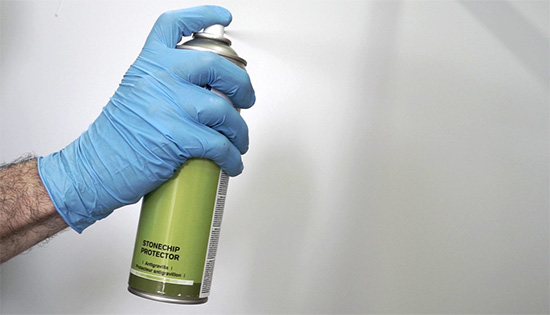
- 1K corrosion protection primers designed to protect surfaces exposed to the effects of rust and corrosion. The most commonly used products are corrosion protection primers, such as ETCH PRIMER 1K, which are applied to bare sheet metal; zinc aerosols, used to coat the inner faces of welded metals and welds; cavity wax, to protect the inner face and hollow parts of the bodywork; and underbody protectors and stone chip coatings, specially formulated to coat the bodywork floor, wheel arches and the underside of door sills.
- One- and two-component top coat paints for coating, enhancing and protecting the visible surface of parts. Within this group we find both enamels and clear coats for coating interior or smaller body parts and other elements such as break calipers or rims.
- Textured paints for covering black or gray plastics with a rough top coat.
- One-component liquid vinyls for painting parts with this type of top coat.
- Fade out thinners used in the transition zones of missing patches on bumpers or bodywork uprights.
For which type of jobs are aerosols not recommended?
Generally speaking, the use of aerosols is not recommended in the following work situations:
- In the coating of larger parts and objects, such as leather elements?? of the bodywork.
- In jobs requiring the highest surface quality, such as car refinishing.
- In the refinishing of parts and objects that are exposed to severe environmental conditions.
- On any part that is likely to be polished at some point. 2K clear coat can be polished

How do you use aerosol paint?
Before using an aerosol paint, it is important to assess the suitability of this format for the work to be carried out, taking into account the fields of application mentioned above. The considerations to be taken into account when using aerosol paint are as follows:
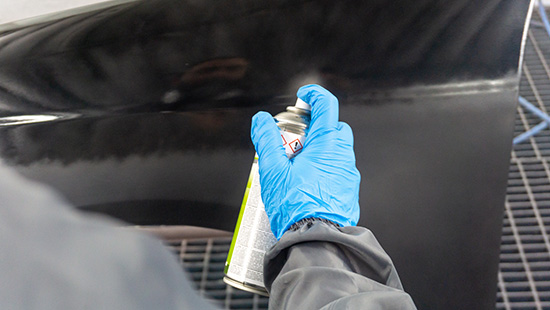
- In 2-component aerosol formats activate the mechanism that allows mixing of these components.
- Shake the bottle for approximately two minutes before starting the application, so that all compounds are properly mixed inside the bottle.
- Carry out a spray test to check that the atomizer is in good condition.
- Apply the product according to the manufacturer’s instructions. Depending on the type of paint contained in the aerosol, the application is generally carried out in one pass for primer paints, and in two passes for top coats. In any case, it is usually applied at a distance of about 25 cm from the part, crossing top coat passes and blurring the application on partial coatings.
- After finishing the application, the aerosol should be turned upside down and the atomizer should be pressed to discharge the product inside and thus prevent the nozzle from clogging. In the case of two-component aerosols, it is not necessary to perform this action, as when the two components are mixed, the remaining contents will inevitably dry.
Aerosol paint: the ideal solution for certain types of jobs
The vehicle refinishing process involves different stages of work. A variety of products are used, many of which are applied with a spray gun. This requires a certain amount of time for the preparation and cleaning of the work tools used. However, the use of aerosol paints for certain jobs, or their introduction at certain points in the traditional refinishing process, allows for an increase in productiv
ity without any loss of quality, and is therefore the ideal solution for certain types of work.