Putty is the first product that is usually used by the painter or bodywork professional in the process of preparing the surfaces for the subsequent application of primer.
What are putties?
Putties are pastes containing a resin (most commonly polyester) and a filler high in talc and/or glass microbeads, mainly. These fillers give them viscosity, volume and a paste-like state so that they have a great filling power.
In a smaller proportion, they also contain coloring pigments and thixotropic agents which, in addition to giving the putty a greater fill, give it texture and creaminess. This texture will facilitate the mixing with the hardener and spatula application. It should be noted that there are also putties that can be used with guns.
What are putties used for?
The purpose of putty is to fill small imperfections in a surface that can be caused by gravel impacts, scratches or other damage caused by an accident. Afterwards it is sanded to level and even out the surface with the rest of the piece.
Putty properties:
In order to fulfill their purpose, putties should have the following properties:
- Good adhesion to the surface on which it is to be applied,
- Good filling power and resistance, especially in the case of putties used in repairs that require greater depth.
- Flexibility to adapt to each material and thickness.
- Easy mixing and application.
- Good finish, providing smoothness and fineness without leaving pores.
- Easy sanding, light and fast drying time to reduce working time.
In the market there is a great variety of types of putties that provide a solution for any type of repair. Each of them has characteristics that are suited to the types of damage and the surfaces on which they are to be applied. Read the following post if you want to find out more about the different types of putties and their differences.
How to apply putty?
To achieve the best result it is important to follow the recommendations indicated by the manufacturer in the technical data sheets.
Surface preparation
- Sand the area to be refinished with P80 grit.
- Polish scratches with at least P150 grit abrasive and finish with P240.
- Blow and degrease the surface with the recommended cleaner.
- Choose the right product depending on the damage and the surface.
Putty preparation
- Mix the resin in the container itself if the liquid and solid parts have separated.
- Check the percentage of hardener that the putty needs, normally 2-3%.
- Calculate the quantities of product that will be needed. If a lot of product is required, you should take into account the pot life of the mixture to check that you will have enough time to use the prepared quantity before it starts to dry.
- It is recommended to weigh the products to guarantee the correct proportions, preventing bleeding defects or lack of hardening.
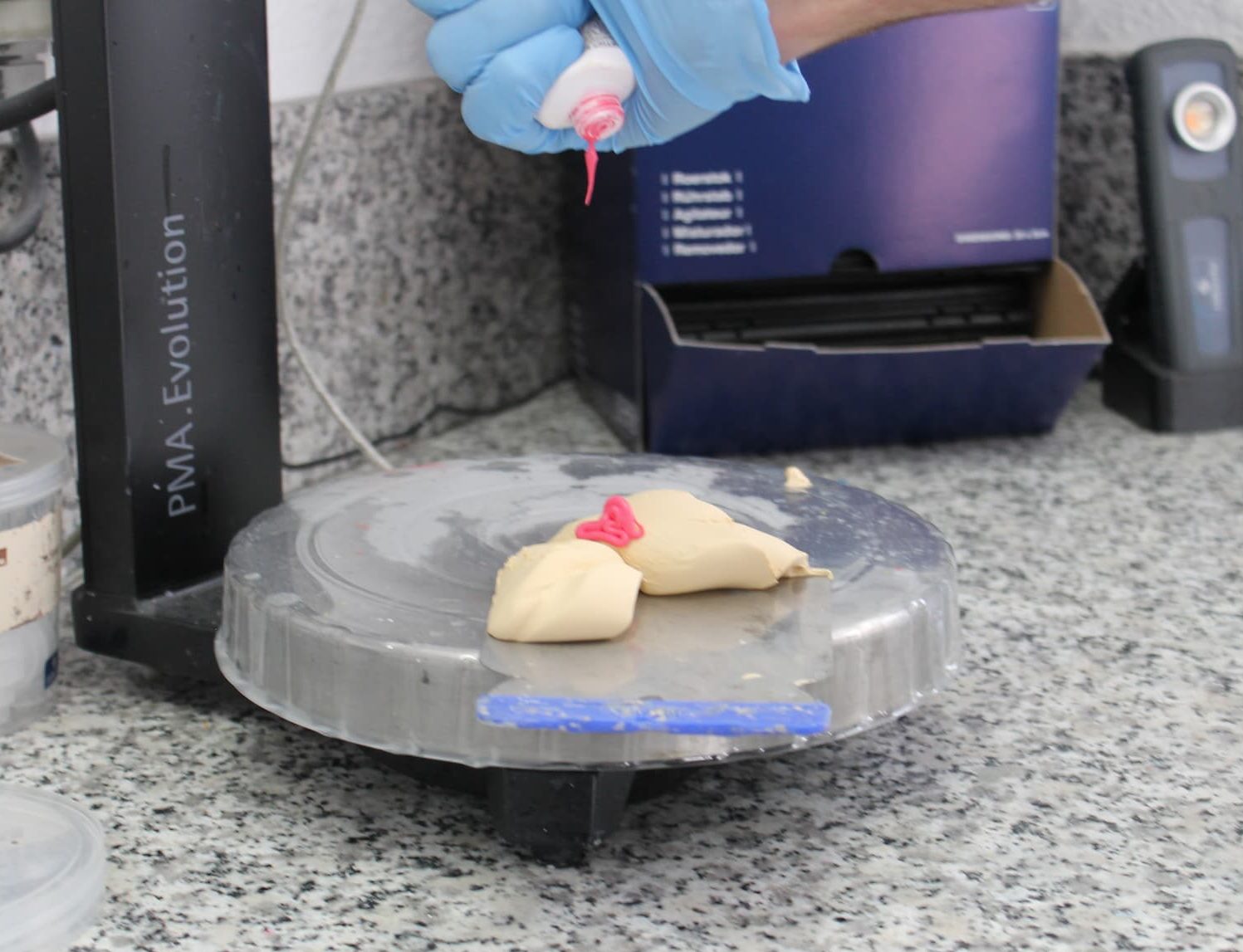
- Mix the hardener well – the peroxide in the hardener is reddish in color so that its correct homogenization can be observed.
Putty application
- Tilt and gently press the spatula to deposit the product and prevent air bubbles from forming inside.
- To reduce spatula marks, start in the center of the damaged area and gradually fill outwards.
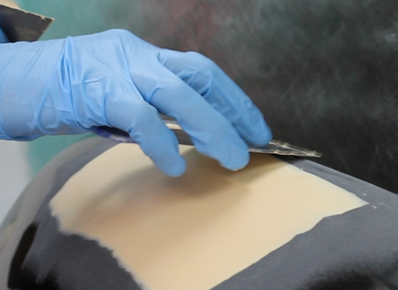
- To complete the application, or for minor damage, shape the putty by making long, uniform and constant strokes from one end to the other until a surface area slightly larger than that of the damage is covered.
- The area should be gone over one more time without any product on the spatula, to clean the surface of defects and application pores.
Some things to keep in mind
- Do not apply polyester putty over vinyl primers, as they are incompatible.
- All polyester putties, due to their hygroscopic nature, must be isolated with primers.
- Polyester putties do not harden at temperatures below 5ºC.
- Protect yourself with the necessary PPE.
In this post we have explained everything you need to know about putties and their application. If you want to learn more and become an expert, sign up for the online putty course taught by sector professionals.