In our first post on useful tips to reduce energy consumption in the workshop, we analyzed the three-star tips aimed at achieving this goal, among which the use of air-drying products stands out, as it offers more than interesting advantages in terms of energy efficiency.
However, there are other options that are also advantageous and that can be perfectly complemented with the tips mentioned in the previous post. Do you want to know which two tips we are referring to? If so, keep reading because we start with them.
2 very useful tips for reducing energy consumption in the workshop
In the first part of the post on 5 useful tips to reduce energy consumption in the workshop, we discussed these three-star tips to increase energy efficiency in the workshop:
- Tip No. 1. Study and control of the energy consumption of the workshop
- Tip No. 2. Use air-drying products.
- Tip No. 3. Perform preventive maintenance.
Although a significant reduction in energy consumption can be achieved with the application of all of them, the reality is that these measures can be complemented with the two tips explained below, which also help significantly to achieve or improve this objective:
Tip No. 4. Optimization of facilities
Facilities are understood as all space and equipment necessary to carry out the activity. In this sense, the basic facilities of the workshop that have a direct influence on energy consumption are lighting, compressed air network, and air conditioning. Thus, the premise to be considered to reduce energy consumption on these three variables is the use of more efficient technologies and demand control.
Regarding lighting, the reduction of energy consumption involves a combination of the following measures:
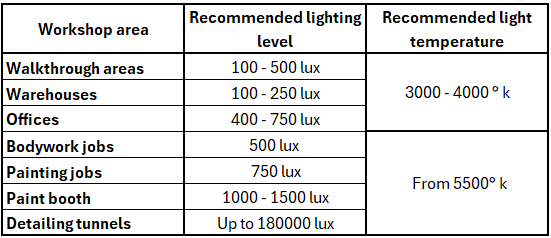
- Increasing the efficiency of artificial lighting. To this end, replace conventional lighting systems with more efficient light sources using compact fluorescent or LED technology mounted on high-performance luminaires. Regarding light temperature, it should be between 3000 and 6500 degrees kelvin (ºK), a value that will depend on the visual requirements of each workstation or space, taking into account that the lower the light temperature, the higher the energy efficiency.
- Carry out a study of the lighting needs and the layout of the luminaires for each area and workstation, to improve the productivity and comfort of the workers, to avoid unnecessary consumption, and to sufficiently equip the different areas and workstations. As an example, this would be an indicative and not exact example of the indicative lighting levels that a typical automotive workshop might require:
- Combine the use of artificial light with natural light through the installation of skylights or similar systems.
- Use light control, regulation and automation systems, since in this way it is possible to improve the quality of light and make a more responsible and sustainable use of it.
From the point of view of the compressed air installation, it is important to install a compressor that perfectly fits the needs of the workshop while at the same time having a perfectly airtight installation without air losses. With this combination, the compressor works less and therefore reduces its energy consumption.
The most recommended and efficient option for body shops are screw compressors o rotary screw compressors, due to their higher efficiency and higher recovery capacity. The size and capacity of the same is an aspect to be studied and depends on the size and workload of the workshop in question.
Finally, with respect to the air conditioning of some rooms in the workshop, such as offices, the use of heat pumps is recommended over other traditional systems such as boilers. The air conditioning installations with heat pumps usually integrate control and regulation systems that adapt their operation to different variables (sectorization, space occupation, etc.).
And to finish with this second tip, it is worth mentioning the possibility of considering the progressive integration of alternative energies, known as green or renewable energies, which can be installed in certain work areas. Within this type of energy, solar energy is the most feasible alternative.
Tip No. 5. Optimization of machinery.
The use of tools, equipment and machines is one of the main consumers of automotive workshops, hence the need to look for efficient options from this aspect.
The first measure to be considered in the paint shop is the possibility of replacing the fuel in the paint booth, changing diesel for natural gas, since this fuel offers better energy efficiency, has a lower cost, is cleaner and requires less maintenance of the installation. In addition to this measure, the use of portable booths and plenums for carrying out certain jobs also helps to reduce energy consumption.
Another measure to take into consideration is to make sure that the large equipment that equips the workshop, or that may be acquired in the future, have high-performance electric motors. Workshop equipment fitted with such motors ends up being more efficient in the medium and long term, thus reducing energy consumption.
Finally, it may also be convenient to evaluate the type of power supply of the different tools used, with the premise of seeking to reduce the energy consumption of the workshop through an adequate balance between electric, pneumatic and battery-powered machinery.
Reducing energy consumption in the workshop is possible
In a highly competitive economic and labor environment, the way to make the business profitable is much more complex than it was a few years ago. However, there are still different ways to achieve this. One of them is to act on energy consumption to reduce it by applying the three-star measures that we saw in our first post and that are complemented by the two tips that we have analyzed in this article.
Of all these tips, remember that the star and most innovative measure is to use air-drying products, so do not hesitate to study this option as a quick and effective way to reduce the energy consumption of the workshop from minute zero.
This is the end of our two publications on how to reduce energy consumption in the workshop. We hope you found them useful.
See you in our next publication!