Putties are some of the most commonly used consumables in repair shops. The evolution of this product in the last few decades has been very prominent, to the point of having a very wide range of them. In this line, manufacturers are incorporating ultraviolet (UV) drying putties into their range. Are you familiar with this technology? We are sure you are, since it is already common to find putties and primers that are cured using UV radiation.
However, the emergence of UV putties is more of a recent thing and you may not know their characteristics fully, so let’s analyze them in detail to learn more about them.
Concept and features of UV putties
A UV putty is a filler product developed to fulfill the same functions as other fillers, i.e. it must effectively fill the small irregularities that remain on a surface that has been repaired so that, after sanding, the surface is perfectly matched and integrated into the rest of the object.
Beyond this generality, UV putties present a series of very specific characteristics that determine their field of application and how they should be used. Among them, the most remarkable is their drying system, which is produced through the reaction between the photoinitiator pigments that integrate the putty and the ultraviolet light projected through lamps designed for this use. This type of drying is carried out extremely quickly, so that curing times hardly exceed one minute, depending on the size of the putty and the power of the curing lamp.
If we take into account that a traditional putty cures in about 25 minutes and UV in 1 minute, the time is reduced by more than 90%, which offers the possibility of significantly speeding up the repair process.
On the other hand, UV putties are also defined by these other features that must be taken into account in order to know when and how they can be used:
- Although these putties are sensitive to natural ultraviolet light, it is essential to use specific ultraviolet lamps for effective drying.
- They are ready-to-use 1-component products, so it is no longer necessary to use a hardener or to do any mixing, which means time saving, a better finish: less porosity and less waste generation.
- They are supplied in small quantities, since their use is indicated for minor and medium repairs.
- It is easy to apply, can be applied in thicknesses of up to 1 mm and in several thin layers to increase the filling.
- It has good mechanical and chemical properties, including high flexibility.
- These products are not affected by the usual environmental factors of temperature and humidity.
- They do not contain styrene in their composition, so they are more environmentally friendly.

When is it best to use a UV putty?
The recommended use of UV putties is determined by the following three aspects that should be known and taken into account in order to obtain the best performance and results from these products:
- The state of the surface being repaired.
- The type of repair.
- The characteristics of the repair shop.
In regards to the state of the surface, UV putties offer two major advantages. On the one hand, they have good mechanical properties, especially in regard to their strong flexibility, while on the other hand they can be used both on metallic surfaces (steel and aluminum), without any prior activation of the surface, and on plastics after having previously applied, as a general rule, an adhesion promoter. Thanks to these two characteristics, UV putty is a polyfunctional filler product that eliminates the need for different types of fillers.
In relation to the type of repair, UV putty is particularly suitable for filling irregularities that appear after the repair of minor and mid-level damage, as well as to effectively cover up small flaws. It is therefore not recommended for use in jobs that require a putty over a millimeter thick, nor for extensive damage.
And finally, the use of UV putties is also especially interesting for those workshops that, because they have small facilities, have a large volume of work or want to offer a fast repair service, and who need to speed up repairs and reduce the stay of vehicles in their facilities. In this sense, if we take into account that UV putties cover a wide range of repair types, this can be a good option to meet or solve these requirements.
How do you apply UV putty?
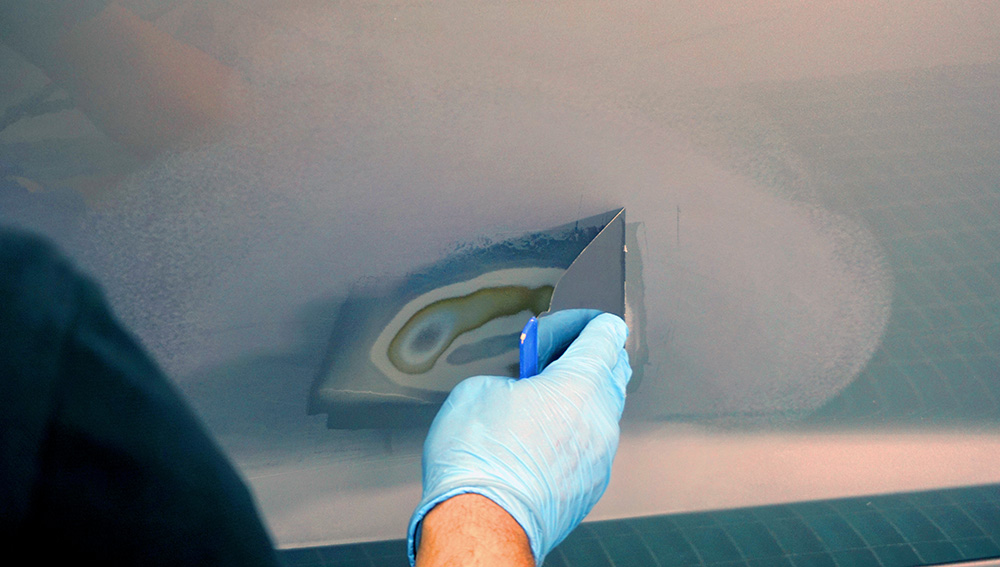
The way to use a UV putty is much simpler compared to traditional filler products, due to the elimination of the need to do any mixing and that it comes ready to use. In any case, the steps to follow to apply it are as follows:
- To carry out the previous preparation of the surface on the repaired damage: paint removal, edge degradation, sanding of the bare surface and perimeter shading of the patch.
- Clean the surface by initial blowing or vacuuming to remove surface dust and subsequent degreasing to remove any embedded contamination (grease, oil, etc.).
- Apply the putty directly on the substrate or on the application spatulas.
- Cover the entire patch with putty and smooth its finish to eliminate edges.
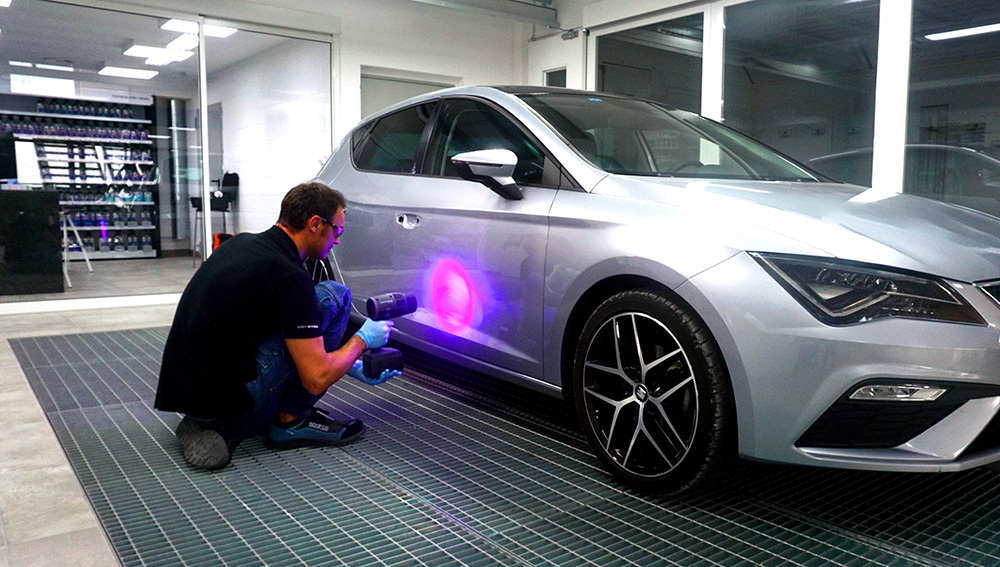
- Dry immediately with UV lamp, preferably with LED technology, at the distance and for the time indicated by the manufacturer.
UV putty: the revolution continues
UV curing products have risen from the ashes to stay with us for good. That is why paint manufacturers are relying on this technology. In this line, UV20 putty is one of the latest additions that is being produced, because, beyond offering fast drying, it is presented as a polyfunctional filler product with good mechanical and chemical properties that covers a wide range of repairs. In addition, its use in combination with a UV primer such as Halley UV200 allows bodyshops to really speed up the repair process.