In the first article dedicated to polishes used in bodyshops, we analyzed the main characteristics of these products in order to showcase the range offered by manufacturers and the technology that defines them. Knowing these aspects gives us the option of selecting the product that best suits the service offered. That said, is knowing this information alone enough? Unfortunately not, since it is especially important to know how to apply a polish, especially when the ultimate goal is to obtain maximum quality.
Before, we recommend you to read this article about polishes
How should the polishes be applied?
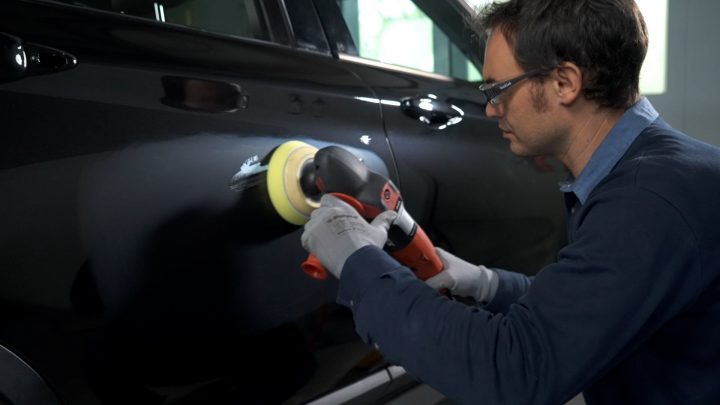
The polishes are applied by means of a rotary, orbital or rotary eccentric polisher on which a sponge is whose hardness is appropriate for the type of polish (harder as the polishing paste has more cutting power). Any polisher indicated fo
- Its design is highly ergonomic in order to reduce operator fatigue in larger jobs, facilitate handling and reduce the transmission of vibrations.
- They have a limited number of revolutions to prevent causing the paint to tear.
- They are equipped with a progressive trigger to prevent marks or damage to the paint from forming once polishing has begun.
- They include a manual speed regulator controlled by the operator that allows for this parameter to be adjusted based on the needs of the polishing, such as reducing speed when approaching sharp ribs, edges or plastic parts.
- They integrate a push-button locking mechanism drive that eliminates the need for the operator to keep it pressed continuously.
- The plate and the pads used are made of foam to ensure that they adapt to the geometry of the piece. Each component has a studied hardness.
On the other hand, the following table details the main characteristics of each of the technologies used in the manufacture of polishing machines:
Rotary polisher:
- Describes a rotating movement.
- Favors cutting power, but tends to generate circular marks.
- Requires proper speed control and working pressure to achieve optimal results.
Orbital polisher:
- They may be double action when the displacement of the plate is radial and orbital at the same time, and triple action when they also incorporate a specific epicyclic gear reducer that increases torque at low speeds.
- Lower cutting power but it optimizes the polishing process.
- Does not cause circular marks.
Rotary eccentric polisher:
- Describes a rotary and an elliptical movement at the same time.
- Allows for obtaining good topcoats with a more limited cutting power than purely rotary systems.
- Does not generate circular marks.
The polishing process is carried out in a sequential and orderly manner based on the manufacturer’s procedural instructions, and as a general rule, the following order is respected:
- Compulsory step. Polish using fast cutting polishing paste, such as ROBERCAR 1000 XTREME, and a pad or hard sponge such as the FOAM S-1000 WHITE.
- Optional step. Polished using intermediate cutting paste, such as ROBERCAR 1100 SMART CUT, and semi-hard FOAM S-1000 YELLOW pad.
- Compulsory step. Polish using a high gloss polish, such as ROBERCAR 1100 SMART CUT or ROBERCAR UF920, and a soft pad like FOAM S-1000 BLACK.
- Optional step. Shine enhancement using a specific product such as ROBERCAR 1200 SHINE and a microfiber cloth.
Roberlo and Krolac brands offer polishing compounds to carry out this process.

Use and precautions whilst using polishes
The precautions that must be taken into account when using polishes are as follows:
- Make sure the work area is completely clean and free of chemical residues to avoid contaminating the surface, as well as free of solids that might generate abrasions and damage.
- Protect any areas that might become damaged using masking tape, especially those made with plastics.
- Carry out a correct preparation of the surface using the damage correction process that better adjusts to the polishing technology used. Conventional fast cut polishing pastes effectively remove scratches from P-3000, while the latest generation from P-1500 and polishes from P-1500 or P-2000, medium cut will easily remove microabrasive scratches from P-3000 to P-5000
- For paints that are not fully cured, intermediate cut polishing pastes with medium-hard sponges are recommended. In this way, the paint does not suffer as much and a finer topcoat is obtained.
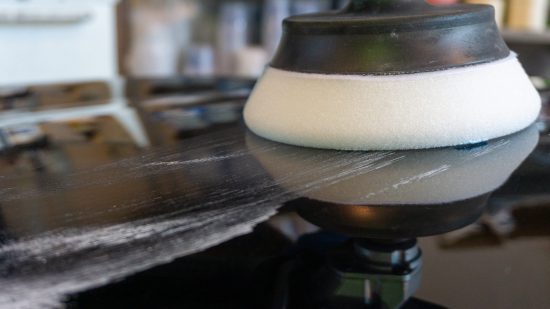
- The polish is applied to the pad or surface in the form of small drops, bearing in mind that an excess of product is not necessary and causes the pad to become prematurely saturated. The machine’s speed must be reduced in order to spread it over the entire polishing surface. Once the work area is covered, the speed is progressively increased until reaching approximately 1200 or 1300 RPM.
- Should the pad present accumulations of polish or saturation, it must be cleaned with water. Any excess water is then removed so that excessive splashing does not occur.
- Polishing is done by painting in different directions causing them to cross each other, exerting a light pressure and maintaining a relatively slow forward speed.
- When working with paints that are not fully hardened or when approaching ribs or edges, it is necessary to reduce the speed and pressure of the polisher and increase travel speed.
- When changing from one polishing paste to the next, the surface must be cleaned to remove any product residue. This prevents certain products from interfering with others, which affects the final topcoat.
- If conventional polishes are used, it is advisable to use a defect revealer or similar products to remove oils and lubricants that mask scratches, in order to verify that the topcoat is correct and to avoid future returns.
Polishing as a differentiating element
The polishing process is postulated as an operation that improves the topcoat and the service offered in different jobs carried out in automotive and car detailing bodyshops. To summarize, ignoring this reality or carrying out these jobs quickly and unprofessionally simply contributes to damaging the bodyshop’s image and prestige.