Talking about polishing inevitably makes us think of refinish shops. Different doubts arise in relation to them, such as whether all polishes are the same or not. What accounts for this widespread use? How are they used? To solve them, we have prepared two articles that collect the most relevant aspects of the products used and the polishing process. Next, please find the first one relating to the types of polishes used in bodyshops.
What is a polish?
A polish is a type of abrasive that allows for restoring the shine, the showiness and the smoothness of a painted surface that has been deteriorated, on which certain painting work has been carried out or where damage has been corrected that affects its topcoat (sanding, paint blurring, etc.) The abrasive that incorporates the polish comes in the form of very fine microgranules and is mixed with a paste or liquid that facilitates its application on the surface in a controlled manner.
Why are polishes used?
As we know, the main reason for using polish is because this product allows for perfecting the topcoat of the work carried out in a way that cannot be achieved with other types of products. This reason is especially important when the objective of the work carried out is to obtain the highest quality, as with the painting of vehicles or the polishing processes carried out in car detailing bodyshops. Beyond this, the use of these products also provides another series of benefits such as the following:
- Customer loyalty by obtaining higher quality topcoats.
- Fewer returns due to having delivered the product or the repair with a poor topcoat.
- Possibility of expanding the services offered by establishing polishing as a marketable service.
- A wide range of polishes is available that adapts to the type of work offered by the bodyshop: Industrial vehicles, top quality polishing, etc.
Types of polishes in bodyshops
In general, the types of polishes may be classified according to their abrasive power and the level of shine they offer, as well as according to their technology. According to their abrasive power and gloss level, the following polishes are available on the market:
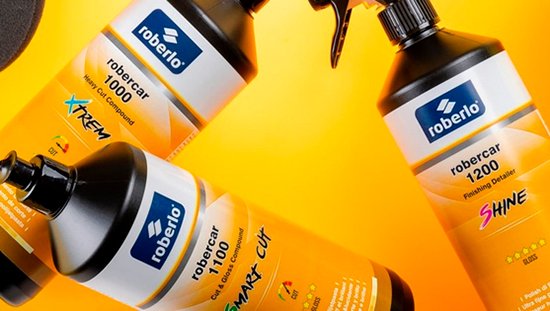
- Fast cutting polishing paste. It is the polish with the highest abrasive power, and it is used to renew deteriorated paintwork, restore the smoothness of the coating and remove scratches caused by sanding operations during the correction of defects. Depending on its technology, it offers standard or enhanced features, such as the Robercar 1000 Xtreme, whose brightness level is good, but insufficient to obtain the maximum possible showiness.
- Intermediate cut polishing paste. Its cutting power is lower than that of fast cutting, so it is optionally used as an intermediate step to reduce the abrasion produced by cutting polishing, eliminate minor anomalies and carry out a more sequenced process that contributes towards obtaining better results. The gloss level it offers is superior to that of the fast cut polishing paste. A clear example is the Robercar 1100 Smart Cut.
- Polisher. It is a very fine polish with little abrasion capacity that provides an extraordinary level of shine. To obtain the best performance of this product, it must be applied after having previously polished the surface using fast and/or intermediate cutting pastes.
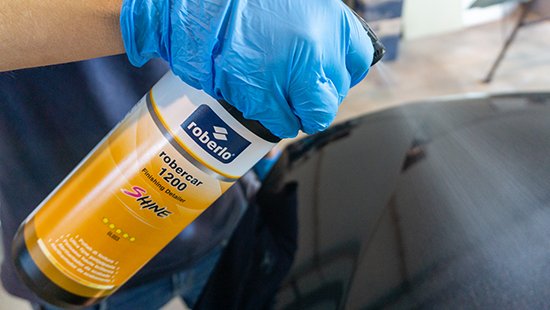
- Shine enhancers. Some manufacturers have developed these products with the sole purpose of obtaining the maximum possible shine on the surface, so that the topcoat really stands out. These products do not have any cutting ability. Robercar 1200 Shine is the latest Roberlo product.
- Anti hologram polish. Holograms, also known as swirls, are circular marks that appear on the painting once it has been polished. This anomaly is seen mainly in dark colors, so when working with these color ranges, this product is applied to obtain a better topcoat. The new generation polishes no longer include this polish due to the optimized performance they present.
As far as the classification of polishes according to their technology, the following ranges are noteworthy:
- Conventional polishes. It is the range of polishes that has traditionally been used in the automotive sector. Although it depends on the manufacturer, the range is usually made up of a fast cut polish, an intermediate cut polish, a polish and an anti-hologram polish. The cutting products have a more limited abrasive power that delays the polishing process, makes it necessary to work with finer grains and requires the use of more products in order to obtain a quality topcoat. In addition, their composition includes oils and lubricants that temporarily mask anomalies and sanding scratches, which distorts the final topcoat and causes their reappearance when these compounds disappear from the polished surface.
- Next-generation polishes. These polishes are the evolution of conventional polishes, so their ultimate goal is the same. However, their features have been improved to increase versatility, so that the cutting capacity and brightness level of all of them have been improved. They allow for performing the polishing process in a single step in less demanding topcoats. Additionally, they do not leave circular marks and do not include oils and lubricants in their composition that mask the damage, so the topcoat obtained after polishing is the one that is maintained over time.

Polishes for all tastes:
Not all jobs are the same, nor are they subject to the same requirements, so having a varied range of polishes allows the bodyshop to use the ones that best suit their needs. However, it is essential to know the products that are marketed and their benefits in order to choose the most suitable one.
And remember that we will soon publish a second article on polishing, where we will talk about how these products are used and the precautions that must be taken into account!