Variants of water-based paint have been marketed for many years in different areas of special relevance, such as the automobile or DIY sectors. However, its presence in sectors where tons of paint are used, such as the industrial sector, has not yet been fully consolidated. Therefore, the following question arises: Is water-based paint well suited to the industrial sector? To answer this question, it is necessary to delve into certain aspects that provide a clearer view of the position to be taken in this regard.
What is a water-based paint?
Water-based or water-soluble paint is a type of coating that fulfills the same embellishment and protection functions as any other type of paint. However, the main difference is that an aqueous solvent is used to adjust viscosity, which results in a less harmful effect on health and a reduction of the pollution load on the environment.
Why does the need to use water-based paints arise?
The need to use water-based paints arises from the environmental commitment acquired by companies and governments in relation to the need to reduce volatile organic compounds (VOC) discharged into the atmosphere as a result of the coating of all types of objects with solvent-based paints. This commitment arose a couple of decades ago, when the first European directives reflecting this need were proposed. Soon afterwards, the European Community forced member countries to transpose these directives into each of their legal systems.

Is water-based paint a substitute for solvent-based products?
Nowadays, water-based paint is considered highly evolved, so it may be used as a quality coating. However, this evolution has not reached all types of paints, so that there are many products that are still solvent-based, because water-soluble technology has not reached the required levels in these cases. Despite this, solvent-based products that do not have a substitute for water have had to be optimized with the introduction of a higher solids content and a lower amount of solvent, in order to comply with current regulations regarding maximum VOC levels of the different paints.
Due to all this, many industrial solutions do not involve making a drastic change from solvent-based paint to water-based paint, but instead combine both systems to obtain a quality result that is more respectful of people’s health and the environment, which is unsurprising considering that this practice has been applied in the automotive sector for a couple of decades, when the obligation to replace solvent-based color bases with water-based paints was implemented.
Why does the question arise as to whether or not water-based paint is suitable for the industrial sector?
The main reason that explains the approach of this dilemma is the cost required to make this change as a result of the adaptive process involved. In this sense, a drastic change would mean investing in new equipment, more expensive paint and employee training.
From an economic viewpoint for companies, this can be a serious problem that affects profitability and the quality offered. But despite this negative aspect, the reality is that companies in the industrial sector should not make such a drastic change, but rather gradually introduce these new technologies in their painting processes so that it does not cause a negative impact.
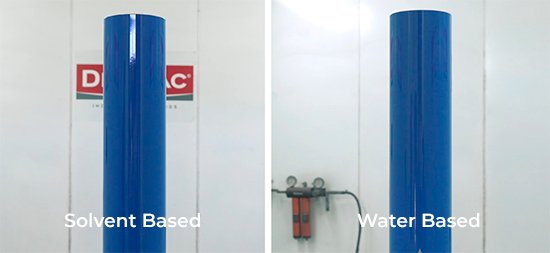
Is water-based paint suitable for the industrial sector?
As we have already mentioned, water-based paints are less harmful to the health of the employees and the environment, which should be enough to use this type of coatings if we take into account that employees and the planet are the best asset that any company may have. Even so, there may be certain reluctance in its implementation within the production process, so other reasons that justify the need for its use are listed below:
- Its chemical properties are infinitely less dangerous than those of solvent-based paints, since in addition to being safer for people and the environment, they are non-flammable, they do not generate self-igniting vapors, their storage does not pose a problem, and their transport and distribution are not subject to any restriction or hazard.
- They improve the image and reputation of the bodyshop or industry, as there is a commitment to the health of workers and the sustainability of the planet, aspects that are more and more valued by society.
- They avoid any type of sanction that may arise from non-compliance with current regulations.
- While it is not a new technology, it has already been implemented in other productive sectors and is working, so the implementation does not imply any radical changes.
Therefore, if we take these advantages into account, it becomes evident that water-based paint is suitable for use in the industrial sector.
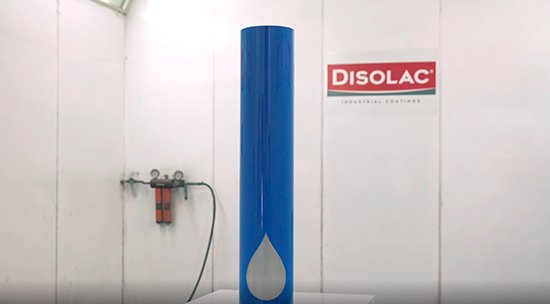
Water-based paint as a social response
There being a clear link between people, companies and society, feedback is constant. The industrial sector is no stranger to this, so it must respond to the social demand for responsibility towards the health of people and the environment. In this sense, the introduction of water-based paints in the production process is an argument for social commitment that meets the needs of our current society.