To understand the underlying reason for the degradation of coatings exposed to solar irradiation, we must first understand how this solar radiation is formed.
Solar radiation is the body of electromagnetic radiation emitted by the sun. This radiation consists of ultraviolet light, visible light and infrared energy. Not all of the radiation emitted by the sun reaches the earth’s surface, with the shortest wave ultraviolet radiation being the most affected. One way to parameterize the solar radiation reaching the earth is irradiation. This irradiation, in turn, has a specific distribution depending on the wavelength, i.e., the same amount of ultraviolet radiation does not reach us as radiation in the visible light spectrum. An example of the solar irradiation spectrum can be found in the following image, which shows the solar irradiation reaching the earth’s surface at noon on a summer day based on the different types of light.
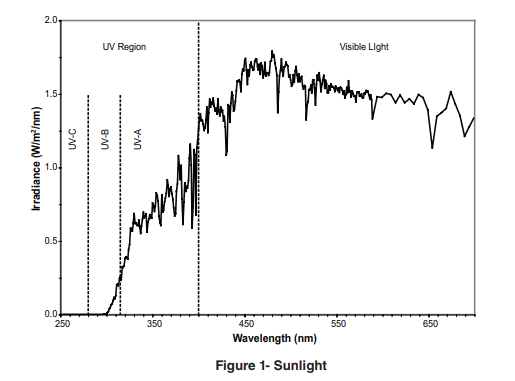
Bearing in mind that the shorter wavelengths are more energetic, we can classify solar radiation into:
- Ultraviolet light: radiation of less than 400 nanometers (the most energetic light).
- Visible light: radiation between 400 and 760 nanometers.
- Infrared light: radiation greater than 760 nanometers (the least energetic light).
Irradiation and its associated wavelength is the most important factor in understanding coating degradation. To cause this degradation in coatings, the chemical bonds that make up the coating must be broken and to break these chemical bonds, the sunlight must have a higher energy than that which binds them. Therefore, the more energetic bands (UV region) will have a greater power to degrade coatings than the less energetic bands (visible light region).
The accelerated artificial aging test is used to evaluate the degradation of coatings when exposed to external solar radiation. Find out how this type of quality test works here.