For most places on the planet, the change of season brings a change in climatic conditions. These natural and inevitable phenomena affect many of our daily habits, as well as the daily work carried out in the paint and body shop. These changes affect the application and finish of the various products used, especially when working with clear coats.
Luckily, paint and clear coat manufacturers take these circumstances into account, offering a range of products that facilitate normal working irrespective of the current climate. So when the seaon changes it’s time to adapt the clear coat.
Seasonal changes are characterized by the variation that occurs in the different climate measuring devices. Among them, those that most affect the clear coat application and drying process and, consequently, its final finish are the temperature, humidity and ventilation. The range of optimal values for applying clear coats and paints are, in general, the following:
- Temperature: between 18°C and 25°C.
- Humidity: between 40% and 60%.
- Ventilation: vertically forced, with no air currents and a recommended average speed of between 0.3 m/s and 0.5 m/s.
Within these margins, the clear coat has the necessary viscosity for quality finishes to be achieved.
However, under conditions outside these values during the application of the product and its subsequent drying, there is a high-risk of the following negative effects:
High temperature:
- Low viscosity clear coat.
- The clear coat dries more quickly and loses its capacity to spread out (leveling).
- Faster solvent evaporation between coats.
- Tendency to lighten colors.
- Appearance of defects such as orange peel, micro-blisters, dry application or adhesion problems of the clear coat on the color.
Low temperature:
- Clear coat too viscous.
- Excessive clear coat drying time.
- Slow solvent evaporation.
- Tendency to darken colors.
- Appearance of defects such as loss of gloss, sagging, lack of paint adhesion, etc.
High humidity:
- Slower solvent evaporation and drying between coats.
- Tendency to darken the color.
- Appearance of defects such as loss of gloss.
Low humidity:
- Faster than normal solvent evaporation and drying between coats.
- Tendency to lighten the color.
High ventilation:
- Lifting of dust.
- Lightens the colors.
- Unstable temperature control.
Low ventilation:
- Poor air circulation and filtration.
- Darkening of colors.
These complications that may appear during the application or after the clear coat has dried also affect the bodyshop’s organizational and production system, as the repair process will be longer than expected due to the need to resolve the problems that have arisen. Therefore, these are the consequences that all this entails:
- Additional investment of time not reflected in quotations or assessments, caused by the correction of defects or repetition of work.
- Lower productivity and financial losses for the bodyshop.
- Higher consumption of paints, clear coats and paint additives which are also not included in the quotations or assessment reports.
- Slowing or stoppage of the repair flow.
- Delivery times not met, reduction in the quality of the service offered and loss of confidence in the brand.
- Workload and stress, leading to an oppressive working atmosphere and a loss of the quality offered.
- Saturation or breakdown of the available equipment, especially sanding, painting and drying equipment.
How are these risks eliminated?
To eliminate these risks associated with inadequate environmental working conditions, it is necessary to:
- Adapt the facilities and equipment to the new ambient conditions.
- Adapt the behavior of the clear coat to the climatic conditions present at the time of painting.
To adapt the facilities and equipment to the new ambient conditions, use ventilation, extraction and filtration equipment (fixed or mobile) such as paint booths and prep stations (suction planes). Paint booths are airtight and allow the temperature and humidity to be controlled in the most precise and constant way. However, the primer preparation process can be carried out in the prep stations but the same ambient conditions cannot be obtained as in the paint booth.
Even so, when the temperatures are already high, it is impossible to reduce the heat inside the booth.
- There is a risk when the ambient temperature is below the ideal range (18ºC) or the relative humidity is very high (above 80%).
- Moreover, there will be risks when the ambient temperature is high (above 26°C) or the relative humidity low (below 30%) and the clear coat is applied in an excessively hot environment, irrespective of the painting equipment used.
For these cases, the behavior of the clear coat must be adapted to the climatic conditions present at the time of painting, with the aim of facilitating the application and obtaining the best finish. And how is this achieved? By using fast-drying clear coats and hardeners when the temperature is low. These are the main characteristics of each option:
- Fast-drying clear coats, designed to be applied when the ambient temperature is low or for urgent repairs. These clear coats speed up the repairs of loose parts and dry more quickly when the temperature in the application area is very low or the humidity very high. Some examples of fast-drying 2-component acrylic clear coats suitable for clear coating vehicles in winter are the following:
ROBERLO’s Unix 550 clear coat which dries in 1 hour 15 minutes at 20°C or 10 minutes at 50°C.
ROBERLO’s Kronox 620 clear coat with a total drying time of 2 hours at a temperature of 20°C or 10 minutes at 50°C.
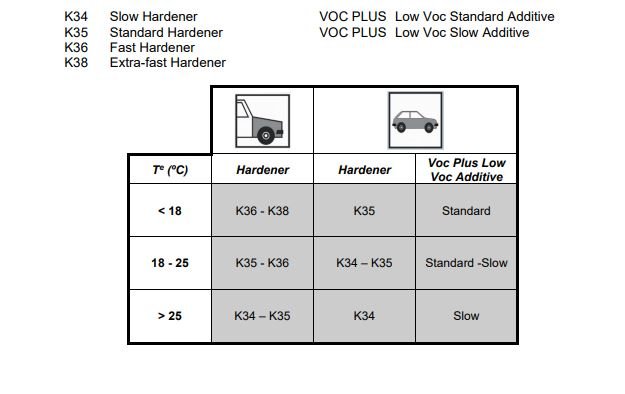
- Hardeners and/or thinners added to the standard drying clear coat, such as ROBERLO’s Kronox 3200 which, in addition to inducing the drying of the clear coat and adjusting its viscosity respectively, have an impact on the drying speed and can be slow, medium, fast, and extra fast. The following table shows the generic temperature ranges for the use of each variant:
Slow:
- These are the variants used for applying the clear coat when the temperature exceeds 25°C or the humidity is very low. It is used for general or partial paint jobs.
Medium:
- This is the standard option used when the temperature and humidity ranges are between 18°C (64°F) and 25°C (77°F) and 40% and 60%, respectively. They are suitable for loose parts, partial or complete paint jobs.
Fast:
- These variants should be used in the mix when the temperature is below 18°C.Also, when the temperatures are low and there is a risk of condensation, it is recommended that the paints are not applied until the vehicle has acclimatized inside the booth.
Extra fast:
- This is the newest variant.It is suitable for applications when the temperature is low and we cannot adjust it.
- Recommended for partial repairs if extra fast hardening is required for certain jobs, or small parts, such as moldings, covers, etc.
Solvents help the application especially when the temperatures are extreme. There are standard and slow versions.
The following image shows two extracts from clear coat data sheets where you can see the temperature range of each one and the hardeners to be used in each case:
Adapt the clear coat to climatic changes
Temperature and humidity variations occur with the changes of season, therefore appropriate equipment and products must be used that are designed for each climate condition. This is the only way to simplify the application process and achieve a quality finish.