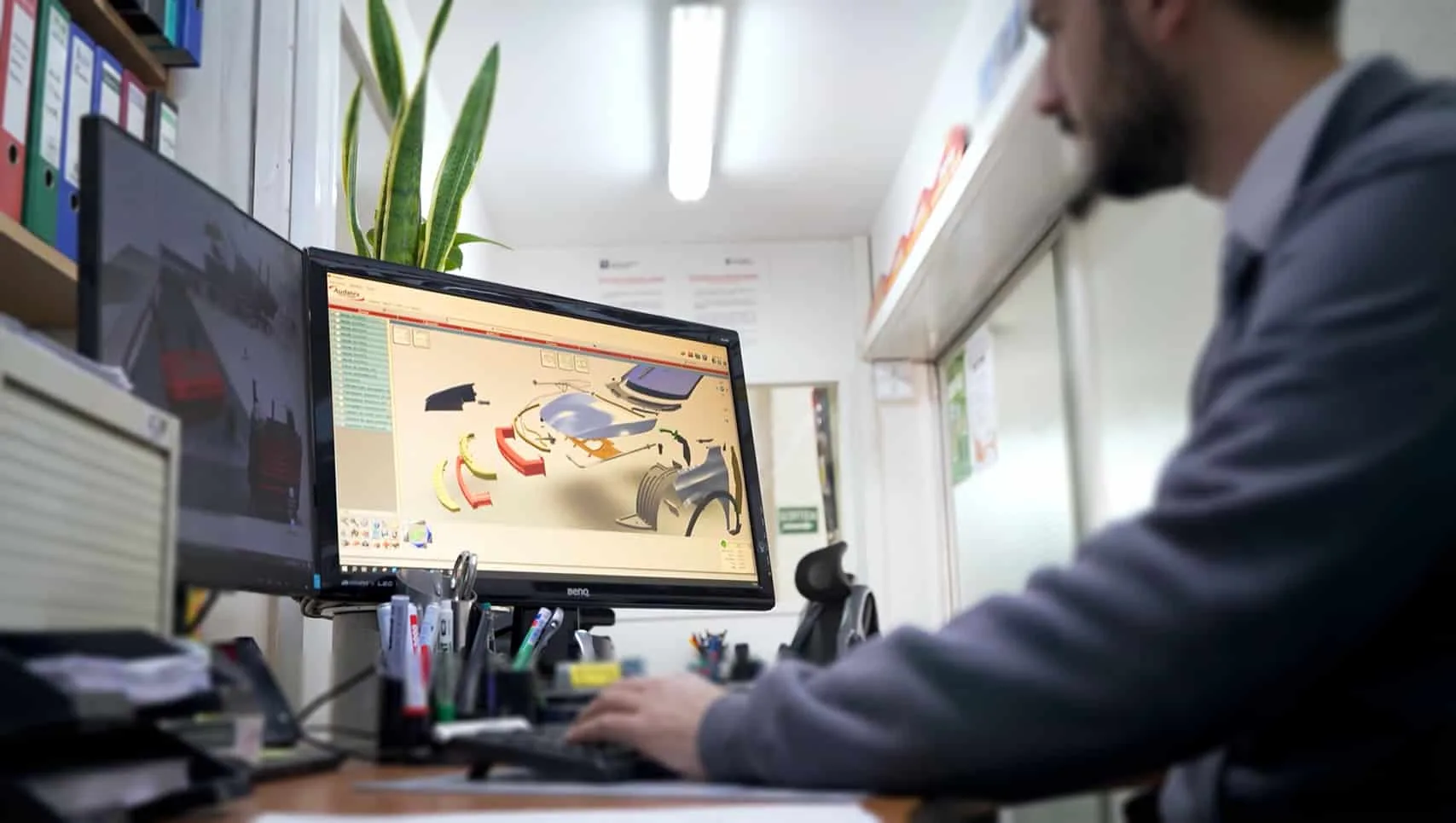
Choosing a color has always been one of the main challenges for the vehicle painter, the exponential growth of products and the proliferation of effect paints have made this situation even more extreme. There are tools that make this task easier, but the spectrophotometer is undoubtedly the most suitable for choosing the most accurate color variant for repairing something well.
Being familiar with the tool and its particularities is essential nowadays, making the vehicle painter’s everyday work easier and maximizing the benefits it brings to the bodyshop as a whole. Here is some useful information to learn more about the spectrophotometer.
What is a spectrophotometer and what is it used for?
A spectrophotometer is an electronic device used to measure the color of a surface. The spectrophotometer works by emitting various beams of white light onto the surface that is being analyzed. The reflected light is collected by a sensor that determines the color of the sample by analyzing the wavelengths. Once the color information has been collected, it is then transferred to the software where it is analyzed and compared with the spectral database. Here the best candidates from the database are determined, i.e. those closest to the sample, and a correction is applied to them to bring them even closer to the original color of the vehicle.
Therefore, from the bodyshop’s point of view, the spectrophotometer is a support tool for painters to help them choose between the best possible recipes. This ensures that we are working with the best candidate for a good match, minimizing the differences between the repair paint and the original color of the car. It provides accuracy, consistency and reliability in a clearly understandable way for any trained user.
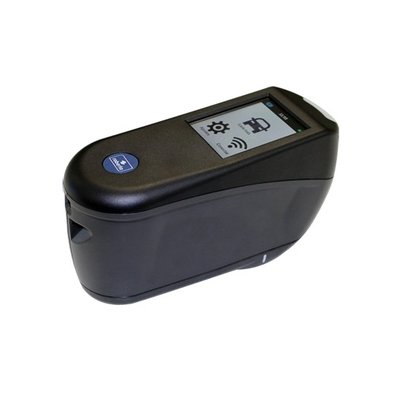
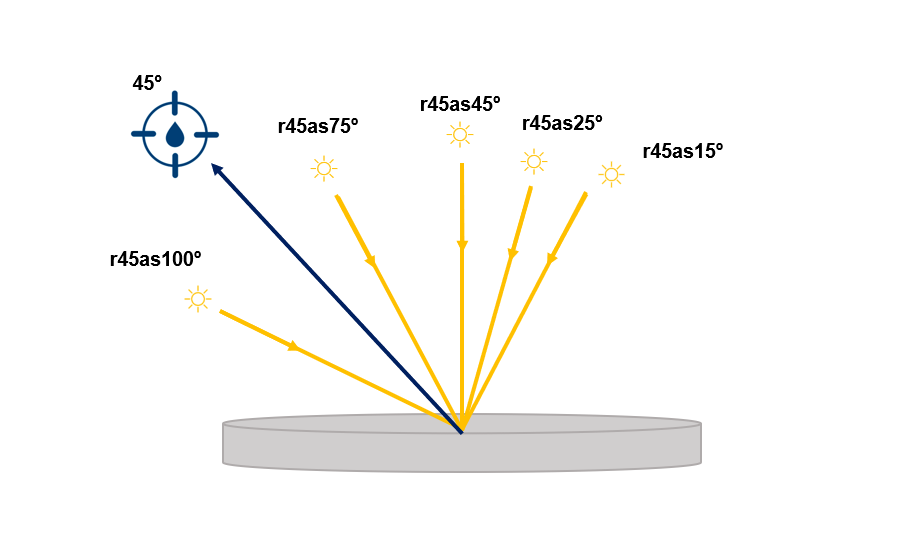
The spectrophotometers used for this process are multi-angle spectrophotometers. These spectra are suitable for the analysis of effect colors. In each reading, we get different measurements (from 3 to 6 depending on the model); in each geometry or angle we obtain changes between the relative positions of sensor, sample and receiver. This helps us simulate the color change according to the observation point. This means that the different interactions of light on the surface are recorded.
While in solid colors light is absorbed, in effect colors, light can be reflected or refracted.
Two of these angles are known in a physical analysis as the face or flop (front and extreme side of a color).
To improve the analysis of effect colors, and in addition to the different spectrum reading angles, particle selection tools or cameras embedded in the spectrum itself can also be provided for the same use. This is because the particle type (size), although related to the readings, is not perceptible by the sensor of a spectrum, so an image or visual comparison is required.
Keep in mind that it is just as important for the technical part to be reliable as it is for the client interface to be understandable, so that the tool can be used effectively and the client has a clear idea of what to do at all times.
Why is it important to have a spectrophotometer in the bodyshop?
The main reason for using the spectrophotometer in the bodyshop is because it determines the most precise and accurate match possible between the original color of the vehicle and the refinish color. Some aspects that reinforce its importance:
- The software database is updated much more effectively than the physical tools.
- The databases, although larger than those of a conventional color chart, are much more manageable thanks to the fast search carried out by the software.
- Each proposal is given a correction to get it even closer to the color that will be duplicated. This causes the possible color variants to grow exponentially so that each color can be transformed into an infinite number of colors close to it.
- There is a preview of the result available before it is painted, which allows us to predict the characteristics of the blending, as well as to vary the search strategy for example when we are not close enough to the code and we perform an open search. This can help us to save paint.
- The selection of the candidate is completely objective, so it eliminates the individual subjectivity to which any evaluation of the color on the vehicle is vulnerable to. A visual analysis could depend on factors as varied as the type of light source, the type of color testing tool used, the visual acuity of each person or the angle from which the painted surface is viewed.
- The spectrum reading is a reading under standard conditions, so the lighting conditions are known and fixed, which then allows us to take into account factors such as metamerism, and this helps in uncontrolled lighting environments such as bodyshops.
- It does not require a complex level of technical knowledge to operate, and the result it offers can be easily interpreted by the vehicle painter. This does not exempt anyone from having a basic knowledge of the tool.
- In most cases, using the tool saves time and helps to improve productivity and profitability of the repair.
- It helps improve the quality of the repair and therefore has an impact on customer loyalty.
Despite all these advantages, it is important to remember that the spectrophotometer has specific characteristics that must be understood in order to manage expectations: for example, when reading matte finishes, since the database generally includes bright colors.
Three-stage or candy colors do not pose a problem for the spectrum as long as there are colors loaded in the database that can be processed. In multi-stage systems, correction is generally not possible and there will be a search process. The use of the spectrum does not exclude the painter from calibrating the second coat.
Vehicles painted with special effects such as chameleon are also not a problem as long as they can be reproduced by the tintometric system and the right ingredients are available.
Get a spectrophotometer in the bodyshop
Color management in the bodyshop to match the refinish color to the vehicle has always been one of the challenges of the automotive refinishing trade.
This has been made even more difficult by the increase in the number of products in recent years. However, with the arrival of spectrophotometers to bodyshops, refinishers now have a tool that makes checking and matching color easier and also helps to improve profitability.
Digitalization is an unstoppable force in many aspects of our work and personal lives. Color is no stranger to this evolving force and we must adapt to a situation that offers multiple advantages.